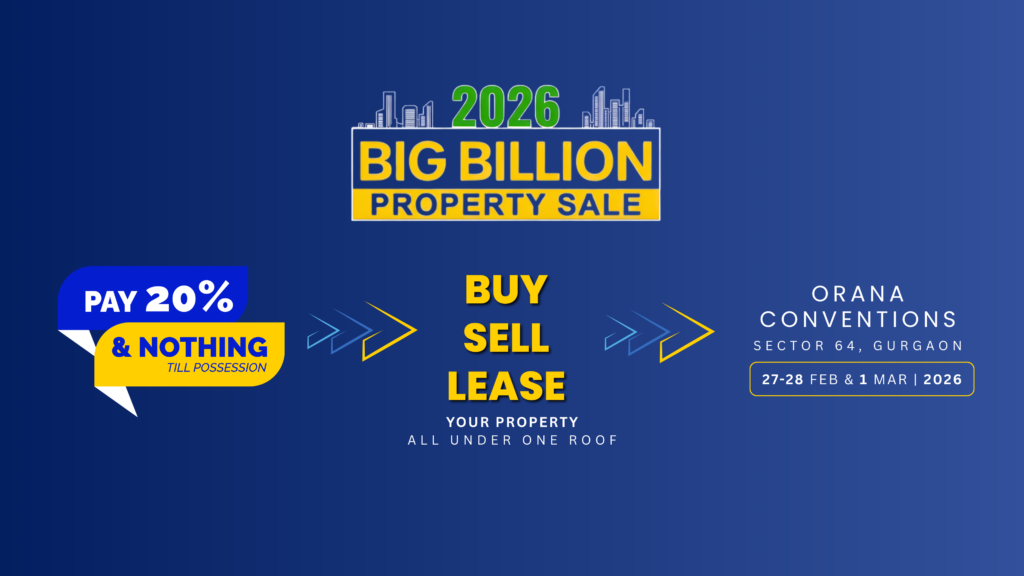
For years, the Indian real estate market followed a linear path: buy, wait, and sell. But as of February 2026, the Gurgaon and Noida markets have entered a “High-Velocity Phase.” With infrastructure like the Dwarka Expressway and Jewar Airport moving from “planning” to “operational,” the 2026 M3M Big Billion Sale isn’t just a marketplace – it’s a tactical instrument for Real Estate Arbitrage.
This year, the narrative isn’t about discounts; it’s about Capital Efficiency. Backed by a verified inventory pool of ₹25,000 Crore across 75+ projects, M3M and Smartworld have engineered an ecosystem where investors can correct their balance sheets before the fiscal year ends. Here is the new logic for the 2026 investor.
1. The “Exit-to-Upgrade” Math (Assure 2.0)
The biggest shift in 2026 is the death of the “Stagnant Asset.” Many investors are holding mid-segment luxury homes purchased at ₹14,000–₹16,000 per sq. ft. that have hit a valuation ceiling.
- The Strategy: Use the Assure 2.0 “Buy From Us, Sell To Us” mechanism to liquidate that equity at a guaranteed benchmark.
- The Arbitrage: Move that “dead” capital into high-growth Branded Residences like M3M Elie Saab or Jacob & Co. While the entry price is higher (e.g., ₹37,000/sq. ft.), the appreciation velocity of a global brand in a mature corridor far outpaces a generic luxury apartment in an emerging one.
- Zero Leakage: By bypassing the secondary market, you save the 4%–6% loss usually incurred through brokerage, marketing, and transfer friction.
2. The “12/12” Commercial Shield: Performance over Projections
In previous years, commercial investment was a leap of faith. In 2026, it is a data-driven science. The Big Billion Sale 3.0 focuses on Operational Credibility.
| Feature | The Old Way (2023-2025) | The 2026 Big Billion Way |
| Asset Type | Investing in “Upcoming” retail hubs. | Investing in 100% Leased assets (M3M Jewel/Route 65). |
| Occupancy | Waiting for brands to sign up. | Collecting rent from brands like Starbucks & Tanishq immediately. |
| Cash Flow | Paying 100% before seeing a tenant. | The 12/12 Model: Pay 20%, then pay the rest 12 months after possession. |
This “Payment Holiday” means you are effectively using the tenant’s rent to subsidize your final capital deployment.
3. The “April 1st Reset” Psychology
Why is the timing of February 27 – March 1 so critical? It’s about the Fiscal Cliff. The Indian market traditionally sees a 5% to 10% price correction on April 1st as developers recalibrate for the new financial year. By transacting in the Big Billion window, you aren’t just getting a deal; you are securing an instant paper-profit of roughly 8% the moment the clock strikes midnight on April 1. This “pre-hike” locking mechanism is the primary reason why inventory during these sale events absorbs 3x faster than regular periods.
4. Spotlight: The “Billionaire’s Block” (Sector 111 & 113)
The 2026 sale highlights the transformation of the Dwarka Expressway into a “Global Enclave.”
- M3M Mansion & St. Andrews: These are no longer just apartments; they are “Safe Harbor” assets. In a volatile global economy, ultra-luxury golf-facing residences have become the “Gold Standard” for wealth preservation.
- The Trump Factor: With Trump Towers in Gurgaon and Noida being high-performers, the 2026 sale offers a rare construction-stage entry into these legacy assets before they reach “Invite-Only” status.
5. Logistics: Navigating the Staggered Windows
To avoid buyer fatigue and ensure micro-market focus, M3M has professionalized the event flow across two distinct chapters:
- Noida Chapter (Feb 21-22): Targeted at the “Jewar Effect” and the Sector 94/128 luxury corridor.
- Gurgaon Chapter (Feb 27 – Mar 1): The flagship event at M3M Urbana (6th Floor, Tower A), Sector 67, focusing on the Golf Course Extension and Dwarka Expressway.
6. The GIC Gateway: Low-Entry, High-Upside
For investors who missed the early boat on the Dwarka Expressway, the Gurgaon International City (GIC) belt in Manesar serves as the 2026 growth frontier.
- M3M Forestia West: This 140-acre integrated township offers a “light-entry” model.
- The Offer: Book with just 10% to 15% upfront, enjoy Zero EMI benefits, and benefit from 20 months of free maintenance post-possession.
As Manesar transitions into a high-end residential hub for the industrial and tech elite, these early-cycle prices represent the highest potential for percentage-based appreciation in the entire ₹25k Crore pool.
FAQs
1. Is Assure 2.0 a cash-exit program? No. It is an Equity Redeployment program. It is designed for those who want to sell an existing M3M or Smartworld asset and move that value into a higher-tier or more modern project within the same ecosystem.
2. What is the “Zero-EMI” buffer in a high-interest environment? With global interest rates fluctuating in 2026, the Zero-EMI until possession offer acts as a hedge. The developer absorbs the borrowing cost, allowing you to keep your liquidity in high-yield debt instruments or other business ventures until the building is ready.
3. Why is M3M Forestia Phase 2 being called the “GIC Gateway”? The Gurgaon International City (Manesar) belt is the new entry point for luxury. Phase 2 offers “Early-Cycle” pricing. If the Golf Course Road is the “Finished Product,” GIC is the “Growth Engine” with the highest percentage upside remaining.
4. Can NRIs use digital escrow for the sale? Yes. For the 2026 edition, M3M has integrated a Blockchain-backed Digital Document system, allowing NRIs to secure specific units and lock in sale-day pricing without the need for physical Power of Attorney (PoA) in the initial stage.
5. Is the “Free First Transfer” really a big deal? For a ₹5 Cr property, a 1% transfer charge is ₹5 Lakh. By waiving this, M3M makes the asset significantly more liquid, allowing an investor to exit mid-construction if a better opportunity arises, without “losing” that initial administrative cost.
6. Does the “12/12 Commercial Model” apply to all projects? No, it is specific to operational and high-intent retail such as M3M Jewel on MG Road and M3M Route 65. It is designed for assets that are already generating or ready to generate immediate rental yields.
7. Are the prices during the Big Billion Sale 2026 legally protected? The pricing and inventory allocations are event-aligned and verified under HRERA (Haryana Real Estate Regulatory Authority) standards. All “Master Stroke” deductions are adjusted against construction milestones for transparency.
8. Can I switch from a Residential asset to a Commercial one during the sale? Yes. Asset-type switching is a core highlight of Big Billion 3.0. You can surrender a residential apartment and redeploy that equity into SCO plots or retail shops to pivot from a lifestyle asset to an income-generating one.
9. What is the “20:20:60” payment structure? This is a popular residential plan where you pay 20% at booking, 20% at a construction milestone (like the 15th-floor slab), and the remaining 60% only upon possession.
10. Why is M3M Elie Saab included in the sale if it’s already high-demand? Even ultra-premium projects participate to maintain sales velocity and reward the “loyalist” investor base. However, inventory in such branded residences is often “Invite-Only” or moves within the first few hours of the sale chapter.